Showing posts with label Purgatory. Show all posts

Thursday, November 20, 2014

Gregory I “The Great” (540-604): Founder of the Medieval Church by Chris White


Gregory I


Rome had once been the powerful center of the civilized world.  It’s monuments attested to the military victories and political will of its leaders to expand their empire and protect and defend their holdings at any cost necessary.  But that was all in a historic past that was growing dimmer and dimmer with every year.  Rome the city was still standing and was an important symbol at least in people’s collective memories, but by now it stood alone, vulnerable, and unprotected by what remained of its own empire.


Into this time was Gregory born in the palace on the Caelian hill that had belonged to his aristocratic family for generations.  His family was well-connected to the wealth and power that remained in Rome, his father being a senator (which must have been more like a town council by this time) and his mother a part of the highest social circles.  Gregory’s family was also Christian and had been so for some time.  In the past, the family had produced two popes, but Gregory had been carefully educated in law and was prepared for a career as a public servant.  By his thirties he had reached the pinnacle of success attaining the office of prefect of Rome which was the highest authority in the city.
But as history has its turning points, often these same events become personal turning points as well.  Shortly before Gregory had become prefect of Rome, northern Italy had been invaded by a people known as the Lombards.  The Lombards were a group from Scandinavia who had been migrating south for centuries prior.  They were a Christianized people and had lived within the borders of the Roman empire for so long that they had even adopted parts of Roman culture.  But need and opportunity came together and in 568 they began to conquer and take the Italian peninsula for themselves.  Although Italy still belonged to the Roman Empire which was now situated to the east in Constantinople, they were ill-prepared to defend this territory and little resistance was able to be made against this warring people.  This problem doesn’t touch Rome or Gregory directly for nearly a decade, but year by year it draws closer and nothing seems to be able to stop it.


In the meantime, when Gregory is in his forties, his father dies and he inherits the family’s great wealth and landholdings.  As he considers the turmoil of his times and watches the great cities of Italy fall to siege, famine, and plague, he makes a rather bold decision: he decides to retire from public life and become a Christian monk.  Since a vow of poverty was part of being a monk, part and parcel with this decision was to take the family wealth and endow 6 new monasteries dedicated to St. Andrew.  Having done this, Gregory retires to the monastery in Rome and embarks on his new vocation of religious life pursuing a life of worship, prayer, contemplation, and acts of charity in preparation for eternal life.  It should be known that Gregory thought the end of the world might be near (a thought many Christians leaders have had during times of social upheaval and catastrophe) and if Christ was to return soon he wanted to be found doing the business of the kingdom of God rather than planning a better sewer and water system for Rome.


Gregory pursued his life as a monk with great enthusiasm and unfortunately, like many man in this career, undermined his health by over rigorous fasting and sleep deprivation; something that would plague him greatly in later years.  Soon Gregory was elected by his fellow monks to be their abbot or spiritual leader and as his reputation grew he was later ordained a deacon by the pope.
Monks carried the gospel to all of Europe


Later Pope Pelagius II asked him to be his representative at the Emperor’s court in Constantinople.  This was a great honor but one in which Gregory was quite ‘tone deaf.  He really never learned much Greek as Latin had by his day become the sole language of Rome and he didn’t care much for the pretensions   of the Byzantine world.  That to say, being a diplomat was not a good match Gregory, but in this time as he frequently corresponded with the pope, his writing skills were noticed and upon his recall to Rome, he was asked to become the papal secretary and in this he served with great distinction.
Gregory encounters Angle children


It is during this time that Gregory and two brother monks have an encounter that was to have an impact on the future history of Europe.  As they were passing by a slave market (and yes, slavery was still practiced in the day) Gregory was impressed with the beauty of some children that were being sold there.  Having never seen people of this race he enquired of one of his companions where they were from.  Upon being told they Angles (English), Gregory was said to have famously replied:  “Indeed they would not be Angli, but Angels if they were Christian.”   Later when he became pope he promoted and supported missions to many groups of people, but closest to his heart were the English and the mission he sent there took hold and firmly tied the Christians of England to Rome for the next thousand years until King Henry VIII made his famous break with the papacy.


In the course of time as Gregory neared his 50th birthday, a terrible plague struck the city of Rome taking as one of its victims pope Pelagius II.  Following his death, a papal election was held and the people and clergy of Rome called on Gregory to take the office of St. Peter.  Gregory at first resisted but saw the need and in 595 AD became the first monk ever elected to the papacy.
Castel San Angelo today


One of Gregory’s first acts was to hold a public procession of humility and repentance before God in hopes of staying the plague that was continuing to rage in the city.  As the procession neared the tomb of Hadrian a vision of the archangel Michael was seen there putting his sword of destruction back in its sheath.  Hadrian’s tomb, now known as the Castel San Angelo, is decorated on top with a beautiful statue of an archangel to commemorate this event.  Surely it is only a pious legend but it is an amazing coincidence that the plague did stop that very day.


As pope, Gregory was an able administrator, tireless worker, and visionary, bringing his monastic viewpoint to bear on the life of the church as well as a mind that had been disciplined in prayer and contemplation.  His pontificate lasted just short of 14 years but in that short span, he put an impress on the church that it was hold throughout the Middle Ages and arguably in some ways still holds.  Let me share some concrete examples.

A great influence on music

Although he did not invent Gregorian chant, Gregory was a hymn writer and poet and wrote in a metered style that was easily chanted and sung by choirs.  Some of hymns are still sung in Catholic liturgy and were made part of the mass.


The Latin mass was largely shaped by Gregory I.  The theology of the Eucharist being an un-bloody but actual repetition of Christ’s sacrifice for the sins of the world precedes his day but Gregory fills the idea with even greater meaning.  When it is served there is a reconciliation of heaven and earth, time and eternity and a spiritual benefit is conferred upon the living and the pious dead in a communion of the church.


In the early church there had long been the belief and practice of offering prayers for the dead.  But in the Christian east purgatory was unknown.   In the west it was an idea that was embellished and came to blossom under Gregory.  To his mind, purgatory was a foregone conclusion.  As each of the Christian faithful died there were remaining sins and infirmities that needed purging before entrance into glory.  Gregory promoted the ideas of saying 30 masses exclusively for the benefit of dead Christians as well as adding almsgiving as an efficacious means of reducing your purgatory time or that of a loved one.  The provision for this eventuality in the life of every Catholic unfortunately degenerated into a form of Holy Fire Insurance over the next millennium.
Dante was famous for his book on Purgatory


Although Gregory would disclaim any jurisdiction over other bishops around the Christian world he definitely held the view that the Bishop of Rome has the commission of Peter and is above all other bishops in Christendom as a first among equals.  He certainly advised other bishops, churches, kings, queens, and nobles, as if he had jurisdiction over them and sometimes this was not greatly appreciated.  Gregory also acted as a head of state.  As Italy’s civil government continued to suffer neglect and further barbarian attacks, Pope Gregory more or less made the church the government.  He organized social welfare and military protection.  He also governed well the many papal lands around Italy, Europe, and North Africa.  This action set the stage for the development of the later Papal States which were their own country with the Pontiff as the governmental head.  Having actual territory under papal governance was a good thing under Gregory as he used the lands to finance and provide food for the poor of Rome, but later popes would become quite distracted with maintaining control of this property to the point of abandoning their spiritual mission altogether.  The point is Gregory may have disclaimed being a monarchial pope in his writings and words, but is betrayed by his actions despite his protestations.

Gregory was a prolific writer and promotes monasticism as the biographer of St. Benedict of Nursia.  He also writes a book that directs priests in their spiritual ministry called the Pastoral Rule.  This book was very insightful and for centuries the textbook on the care of souls.  Gregory is also the person who articulated the idea of the 7 deadly sins:  pride, covetousness, lust, envy, gluttony, anger, sloth or apathy.  Although he borrowed the idea from the early church, he promoted it and transmitted in his writing to future generations.
Papal throne of Gregory I in Rome


Pope Gregory was untiring in his service to the poor caring for thousands in Rome.  He stood up for the rights of widows and orphans.  When he sat down to a meal, it was never before taking the food prepared for him off the table and giving it to the hungry.  He even sold expensive chalices and sacred vessels belonging to the church to help Rome’s impoverished.   Gregory personally punished himself if anyone died of starvation in his city.  Although some later popes were very much guilty of indulging their pleasures, this pattern of charity for the most part has remained a tradition within the papacy.
Gregory I tomb in St. Peter's today


Upon his death in 604, Gregory was immediately beatified (made a saint by the church) by popular acclamation.  In the 11th century the church began referring to him as “the Great” a title that has only been applied to one other pope in the entire history of the church.  In the 13th century Gregory I was declared  a Doctor of the Latin Church in 1298 by then Pope Boniface VIII (one of the few things he did right).  “Doctor” in Latin means a teacher and so this classification denotes an important contribution was made to the teaching of the church in their lifetimes or through their writings.  The Protestant 19th century historian Philip Schaff sums up his life well:  “Goodness is the highest kind of greatness, and the church has done right in according the title of great to him rather than other popes of superior intellectual power.”

Sources

Bede.  A History of the English Church and People.  (London : Penguin Books, 1968)

Collins, Roger.  Early Medieval Europe 300-1000. (New York : Palgrave Macmillan, 2010)

Dawson, Christopher.  Religion and the Rise of Western Culture.  (New York : Doubleday, 1957)

“Gregory I”.  Cyclopedia of Biblical, Theological, and Ecclesiastical Literature.  McClintock and Strong Eds.  (Grand Rapids: Baker Books, 1981)

Gregory the Great, bishop of Rome.  The Pastoral Rule.  James Barmby D.D. trans.  (Peabody : Hendrickson Publishers, 2004)

Ferguson, Everett.  Church History Vol. 1: Christ to Pre-Reformation. (Grand Rapids : Zondervan, 2013)

Kelly, J.N.D.  The Oxford Dictionary of Popes.  (Oxford : Oxford University Press, 1986)

La Due, William J.  The Chair of St. Peter: A History of the Papacy.  (Maryknoll : Orbis, 1999)

Peterson, Curtis, Lang and.  The 100 Most Important Events in Christian History.  (Grand Rapids : Revell, 1994).

Schaff, Philip.  History of the Christian Church vol. 4: Medieval Christianity 590-1073. (Grand Rapids : Eerdmanns, 1994)

Saturday, April 26, 2014

An Evangelical Looks at the Canonization of John Paul II and John XXIII by Chris White


St. Peters Basilica in Rome


     Roman Catholics are not the only Christians who have saints.  Protestants have them too.  Even non-religious people have some regard for this idea of sainthood.  I think it is intrinsic to our humanity to take note of other human beings who have lived well and have achieved great things and desire to be fed in some way by reflecting upon their memory.  In modern parlance we call this mentoring.  In fact, the other day I was reading a leadership blog where the author suggested continually reading the biographies a great people as a means of securing mentoring from some of the most excellent people of all time.  Sainthood in a sense recognizes those individuals in Christ’s body who have lived out their faith in such a way as to be an extraordinary example.  In a way it’s holy mentoring.


      Having said that, Roman Catholic sainthood is much more than being an example of heroic faith and virtue.  It is inclusive of this idea, but there are many entailments to sainthood that touch on Christian theology and praxis for Catholics that are not generally known to non-Catholics.  Even though I am not nor have ever been a Roman Catholic, I have studied and taught Church history for many years and this has required me to attain a familiarity with the history and theology of the Roman Catholic Church which was until the Reformation, the only church of Western Civilization.  In this essay I want to explain a bit of the history and theology of this practice and having done that, I will then turn my attention to the significance of the lives and canonization of Popes John XXIII and John Paul II. 

Christians were persecuted by Roman society

     The notion of sainthood comes from the ancient Christian church during the period of Roman persecution (approx.67 -312 AD).  Those persons who gave witness to their faith in Christ while enduring horrific torture or execution were revered by Christians as the perfect example of faith and love towards Christ.  This was mostly a local affair and its practical outworking was usually a gathering of a local congregation at their tomb on what they called the person’s “birthday” which was day they were martyred and woke up in heaven.


     After persecution ended under the emperor Constantine this practice continued to include persons in the church who were known for their piety, heroic charity, or even great knowledge of God.   Like many things people do, over time there came to be the need for some order and regulation of this practice.  Eventually a process developed roughly 1000 years ago where a case had to be made with actual witnesses to a potential saint’s sanctity and there was the additional witness that when people sought their intercessions, miraculous healings or results were experienced.  If a credible case could be made and stood up to scrutiny, the pope as head of the church would officially enter their name into the list  of the church’s saints.  This final step is called canonization.

The Pantheon in Rome

     There is another historic thread that I wish to pull on that might give further insight into how this practice began and was extended.  When the Roman world was largely pagan this didn’t mean it was not religious.  Actually the Romans and Greeks had a god for everything and nearly every level of society had fraternities dedicated to one god or another.  In most Roman families there was also the veneration of one’s ancestors and on certain days, feasts and prayers offered in their honor.   As Christianity took greater hold of Roman society many times the pagan shrines so common in their folk religion were repurposed and retooled to become places where saints could be honored.  One of the great buildings of the ancient world was the Pantheon in Rome.   The word Pantheon is a combination word meaning “all gods” thus this was a grand temple to every god.  Later this was converted to Christian church in the early Middle Ages.  In Egypt, a civilization known for a multitude of gods, I have visited temple after temple that had the faces of gods chiseled out and crosses cut in pillars indicating they had been converted to houses of Christian worship in the early Christian era.  By no means am I suggesting the practice of canonizing saints is paganism is Christian garb.  What I would suggest is that all cultures have habits of the mind that are deeply entrenched.  God doesn’t wipe our brains clean at conversion like a computer memory card, but rather over time converts even our patterns of thinking and behaving to be Christian.  The reverencing of people who are great examples of the Christian faith seems to me to be a far greater replacement to a pantheon of pagan gods.  Replacement of bad habits and ways of thinking is certainly in concord with the process of Christian conversion.


     From my protestant perspective there are a few issues regarding saints that I find disturbing.  I cannot find direct references in Scripture that either commends or condones the practice of honoring certain saints or seeking their intercession.  As I have studied and sought to understand this practice by reading Roman Catholic theology, the understanding I have is that Catholics do not and are not taught to pray to the saints, but rather they ask for the saint’s intercessory prayer to be offered and added to those of Christ and the angels before the throne of God on their behalf.   The premise of this belief is that the body of Christ includes those living on earth and in heaven.  Just as it is scriptural for me to pray on behalf of my brothers and sisters and to seek their prayers and intercessions, it is just as scriptural to enjoin the prayers of my brothers and sisters in heaven.  While I find this line of thinking at least cogent, it’s other entailments strike me as being imported to the understanding of scripture.  For instance the Bible teaches that all Christians are saints and all are judged by the Lord regarding the reality of their righteous works and rewarded accordingly.  That is the plain reading of scripture.  But what of capital “S” saints who are assigned specialty areas for their intercessions?  For example St. Jude is who you turn to if you are faced with a hopeless situation or St. Teresa if you suffer from migraines.  Having specialty intercessors like this strikes me as quite odd, but perhaps this is a continuation of the manifold gifts of the Church as mentioned in Ephesians 4 and 1 Peter 4.

Souls released from Purgatory

     Another dimension to the canonization of saints is that the sainted person must have been the cause of two miracles that can pass the scrutiny and investigation of the church here on earth.  The declaration of the church is that they know this person is in heaven.  Part and parcel with that is the belief that most Christians, at least Catholic ones, go to purgatory immediately after dying.  Purgatory is loosely based on 1 Corinthians 3:13 which teaches that the believers works will be tested by fire.  Testing by fire relates to the purification of ore and the idea is that a Christian goes through a purification process before entering the presence of God where the last vestiges of our worldliness and sin nature are extinguished.  For some this may be a brief stop, for others who did not cooperate with the Holy Spirit in their sanctification during their lifetime on earth, this may be 1000’s of years.  When a saint is canonized it is a declaration by the church that this particular person had such sanctity that they have passed on through purgatory and now dwell in glory.


     It is this belief and the Roman Catholic church selling opportunities to people to buy themselves or their loved ones a shortened stint in purgatory that was at least partly the cause of the Roman Catholic/Protestant split almost 500 years ago.  Although the Roman Catholic church has outlawed the sale of these privileges for cash money, it is not inaccurate to say they are offered freely by the church for visiting the grave or relics of a saint.  It is also true that by placing yourself in close proximity to such things that your prayers are more empowered and God gives great blessings.  To my knowledge these beliefs are not required of Roman Catholics, but are certainly taught and considered very traditional and mainstream.   Anyone who knows me, knows I have an abiding respect for the Catholic church and its long journey through human history.  I also believe in the power of holy biography (such as stories of the saints) which serves the church by helping its people see the scriptures lived out giving us an example to follow.   But as a Protestant, I place the authority of belief and practice within the Scriptures alone and don’t see in them a clear teaching that would make the canonization of saints anything more than a long and venerable tradition without the benefit of Biblical roots.


     While I do question the exegetical conclusions of some of these verses used on them, I would recommend these sites for a sympathetic reading on the Roman Catholic ideas and thinking regarding the intercessions of the saints and the process of canonizing them.  As I do this I invoke the protection of the evangelical saint C.S. Lewis (who was neither evangelical or saintly) who said the best way to understand someone you disagree with is to read sympathetically seeking to understand their point of view rather than resorting immediately to arguments from the opposition.   I try to practice this myself and recommend it wholeheartedly as it leads to honesty and understanding both of which contribute to civil debate and clarity of thought.
Sites :
       Having explained a bit of the theology and practice of the Roman Catholic church regarding saints, I turn now to the lives of John XXIII and John Paul II and speak of their importance to all people, but especially to Christians of all affiliations.   The best definition of a saint I have ever heard is that a saint is a person who makes it easier to believe in God.  In both cases, John XXIII and John Paul II have met that standard.


Pope John XXIII (Angelo Giuseppi Roncalli 1881-1963)
One of my favorite anecdotes about John XXIII was a story he told on himself about lying in bed late one night pondering a theological question for which he couldn’t find an answer.   Half asleep he finally resolved that he would just ask the pope about it.  A moment later, he shot up in bed realizing he was the pope.  Well, he said, I guess I’ll just have to ask God directly on this one!   Another story is told about John XXIII that a reporter asked him how many people actually work at the Vatican.  He paused for a moment and with a mischievous smile said “about half of them”.

     Before becoming pope, Roncalli  was a Vatican representative in several Eastern and Western European countries and during World War II was well-known among the Jewish community for helping people escape from Nazi persecution.  As the pope, John XXIII was known for sneaking out of the Vatican at night and quietly ministering to people in Rome’s poorer neighborhoods.  No doubt this was the inspiration for the story line of Shoes of the Fisherman (1968) in which Anthony Quinn who plays a future pope who frequently spends his nights helping care for the poor of Rome dressed as a common priest.

Baldassar Cossa (Antipope John XXIII)

     Taking the name John XXIII was a statement regarding the Western Schism (1378-1418), an event obscure to most people today but shook Europe to the core when it happened.   There had been a split in the papacy with two popes claiming legitimacy at one time and even for a brief time three popes.  One of the popes of this time period named Baldassar Cossa  took the name John XXIII.  In taking this name in 1958, Cardinal Roncalli was stating this past pope from Florence was never a legitimate pope.


     John 23 began calling for a new church council 3 months into his papacy.  His election was a complete surprise (especially to him) and it was expected that because of his advanced age his would be a short, caretaking papacy.  It was short, but monumental.
His theme for this council was aggiornamento or bringing up to date.  Vatican II promulgated no new doctrines, but instead signaled to the world that it was moving in a direction of speaking to it rather than reacting against it all the time.  Although, John XXIII died before the council was over, the next successor of St Peter, Paul IV continued the council and brought to a conclusion.

Vatican II Council

     The 2nd Vatican Council revised Catholic liturgy calling for mass to be said in the local tongue of a congregation instead of Latin (although Latin was acceptable).  Vatican II also opened the doors for more interfaith dialogue between the Vatican and other Christian denominations and non-Christian religions.  It was this council which changed the status of Protestants from heretical sect to “separated bretheren.”
     Even as Vatican II moved in the direction of vernacular language for mass, John XXIII himself insisted that the actual church council use Latin as well as all Catholic seminaries were to  teach in Latin.  He believed if the church spoke with a universal language there would not be less confusion and misunderstanding.  However, the reality was that many of the bishops around the world really didn’t understand Latin at all and in many places the Latin mass was jettisoned for a vernacular one just minutes after the closing benediction of the council.


     The 2nd Vatican Council did not establish a worldwide unity of Christian communions, but it was truly the most ecumenical of all councils throughout the 1600 year history of having them.  2500 bishops, cardinals, patriarchs, monks, and denominational representatives were present at the council.  Pope John XXIII had reached out to protestant and orthodox leaders as well inviting their attendance and participation.  And while this had limited success due to centuries of animosities (many of which were legitimate grievances on the non-Catholic side), it did set the stage for a future thawing of relationships in the last quarter of the 20th century.

     It is an interesting detail that Bishop Karol Wojtyla (later John Paul II) was one of the delegates at the Vatican II Council.  It was led by the elderly John XXIII who wanted the church to update itself while Wojtyla, a young man, opposed many of the changes and wanted to stick with the traditions of the church.


     John XXIII’s viewpoint on religious liberty changed  a long held mental habit of the Catholic Church.  It had been the tendency of the church to demand religious liberty of others in places where it was a minority, but deny it to others wherever it had ascendancy.  In his encyclical Pacem in Terris, John considered it a fundamental human right for all people to worship according to the dictates of their conscience.  This did not mean he was a universalist per se, but as someone who considered himself to be a universal leader on behalf of Christ, he wanted to speak to all people as equals respecting their dignity and rights as God does.

     In his lifetime people called him “The Good Pope”.  He had a reputation for being a humble and caring man without any of the pretensions of royalty and privilege that were exercised by popes in the Medieval and Renaissance eras.  This was something he and Pope John Paul II shared in common.  They were both men of humble backgrounds and when raised to high office, both shepherded their church in great humility.  The tradition seems to be continuing with the current Pope Francis who is also quite popular especially among those who have been marginalized by society.


Pope John Paul II (Karol Wojtyla 1920-2005)
     John Paul II was by every measurement one of the greatest and most surprising popes to have ever led the Roman Catholic church.  He was elected in 1978 which is known as the year of the three popes.  Pope Paul IV started the year and died in office, then John Paul I, the smiling pope was elected but died a month later.  There have long been rumors that his sudden death was suspicious, but the papacy is an office usually held by men of advanced age (and hopefully wisdom) and mortality certainly comes with the territory.  At the end of the conclave, John Paul II is elected.  Not only was the Polish Bishop and Cardinal the first non-Italian to hold the office for many centuries, but by papal standards he was a young man being only 58 years old at the time of his elevation.

JPII in Poland 1979

     John Paul II will always be remembered as the one who began the end of communism in Eastern Europe in his visit to Poland in 1979 some ten months after beginning his papacy.  He wanted to visit his homeland and the communist government of Poland reluctantly welcomed him all the while trying to subvert any impact he might have.  John Paul never directly confronted the communists but called his homeland back to Christ and to be a witness in the world.  He also taught that God is in charge of human history and man suppresses this at his own risk.  Millions of Poles attended the open air masses put on by the Pope and they took his message to heart.  At that moment communism collapsed in Poland and this collapse spread eventually to even Russia.  John Paul believed his elevation to pope was part of God’s plan for Poland and the Slavic peoples.  As history played out, God won over communistic atheism.

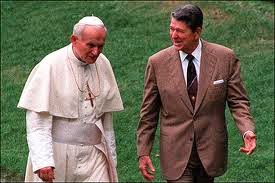
JPII and Reagan on State visit

     In May 1981, a Turkish terrorist nearly assassinated John Paul II in St. Peter’s square.  I will never forget that day as I had just started working in a newsroom.  As the junior reporter I was given the privilege of changing the ribbon on the old teletype machine (a filthy job and therefore given to subordinates) which required turning the machine off for a few minutes.  When I turned it back on the machine started ringing its bells which meant a news flash of something so important programming was usually interrupted.  Needless to say, hearts were racing as just months before an attempt was made on President Reagan’s life and now another world leader in jeopardy.    Several years ago an Italian commission ruled that the assassination attempt was linked to the Soviet Union in retaliation for his support of the pro-democracy movement in Poland.  In 1983 he met with his assassin in jail and offered his forgiveness.


     That John Paul was considered a world leader is without question.  But he was also labeled by many as a bit of a rock-star pope as well.  That’s hard to deny since his papal visits all over the world (over 100 different countries) filled arenas and coliseums and young people from all over  would pack out his World Youth Day appearances.  Even as his body was ravaged with Parkinson’s disease in his last years of life (he lived to be 85) he continued his public appearances to the delight of the multitudes.


     In 2013 I visited Poland and was able to tour John Paul II’s childhood home in Wadowice as well as see the bishop’s palace in Krakow where he resided before going to Rome.  The memories of him and the affection for him was palpable there.  He was a devoted Christian man and scholar but also a man of the people.  He was an athlete but also an actor, a theologian but also a poet.  As a protestant, I’ve always looked askance at his Marian theology and devotion which was extremely great.  But his life story included being bereft of his mother at a very early age and being raised by his widower father.  We in the church have long looked to Christ to be a father to the fatherless.   Perhaps for this man in particular, Mary was a mother to the motherless.  


     John Paul’s pontificate was the second longest in history and the longest of the 20th century.  He was loved by Catholics but greatly admired by Protestants alike as a man of God, goodwill, and prayer.  As pope,  I think his record of seeking reconciliation and peace is unprecedented.  Not only were historic wrongs done to the Protestants and Jews apologized for, but John Paul apologized for the Church’s participation in the African slave trade and even for the 4th Crusade of the Middle Ages that attacked shamefully the Christian city of Constantinople.  Efforts were also made that resulted in a joint theological statement between Catholics and Lutherans on their many agreements regarding the doctrine of justification; something centuries ago caused them to anathametize one another.


     Of course late in his pontificate, John Paul presided over the priest sex abuse scandals.  His efforts seemed too little, too late, and often tone deaf to the victims and their families.  On balance, when this came to light he was a very old and sick man and the people around him may not have done their best in this situation.  Nonetheless, John Paul II finished life well.  At his funeral  many cried out “Santo Subito!”  Sainthood now.  Many saints in the past were declared so because of popular acclaim and many people considered Pope John Paul II a saint while he was alive.


In the cases of both men the traditional rules for canonization are being breached.  Pope John XXIII is only credited with one verifiable miracle instead of the required two, while John Paul II is being canonized a mere 9 years after his death.  Normally a case for sainthood is not allowed to be opened until 5 years after a person’s death and it is not uncommon for the entire process to decades and even centuries.  This gives room for the memory of a person to mature in the minds of others but also time enough for their virtue to be challenged by contravening facts if there are any.  Put another way, if there are skeletons in someone’s closet, 5 years is enough to hear if any of them are rattling.  It is not a foregone conclusion that a pope will become a saint (some of them have been murderers, criminals and some have even been thought to be aligned with the devil, but that’s a whole other story!).  Out of the 266 popes only 81 have been canonized.  This was unprecedented in church history that two popes would be canonized at the same time and they bring the official number to 83.


Sources: 
Johnson, Paul  Pope John XXIII.  (Boston : Little, Brown, and Company), 1974
Noonan, Peggy  John Paul the Great.  (New York: Viking), 2005
Woodbridge, John D. and Frank A. James III  Church History from Pre-Reformation to the Present Day :      The Rise and Growth of the Church in Its Cultural, Intellectual, and Political Context V.2  (Grand Rapids : Zondervan), 2013